How to Choose the Right Chain Sling for Lifting Applications
The right chain sling comes down to four factors: load capacity, chain grade, lift angle, and working environment. Overlooking any of them can lead to unstable lifts, faster wear, reduced lifting efficiency, or unnecessary replacement costs.
Fortunately, once you understand how these factors influence lifting performance, choosing a suitable sling becomes much easier. If you don’t know how, we’ll show you.
At RUD Engineering, we’ve been working with industrial lifting systems for over 40 years. This guide draws on that experience to help you evaluate load requirements, compare configurations, and select fittings suited to your environment.
Let’s start with the basics.
What Are Chain Slings and Where Are They Used?
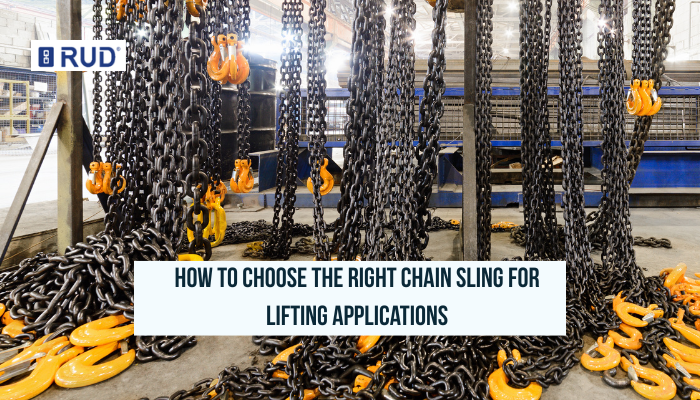
Chain slings are lifting devices made from high-strength steel chain, designed to move heavy loads safely in industrial settings. They connect to a crane or hoist at the top and attach to the load below for a stable, controlled lift. And compared to wire rope, they also hold up better in high heat, around sharp edges, and under heavy abrasion.
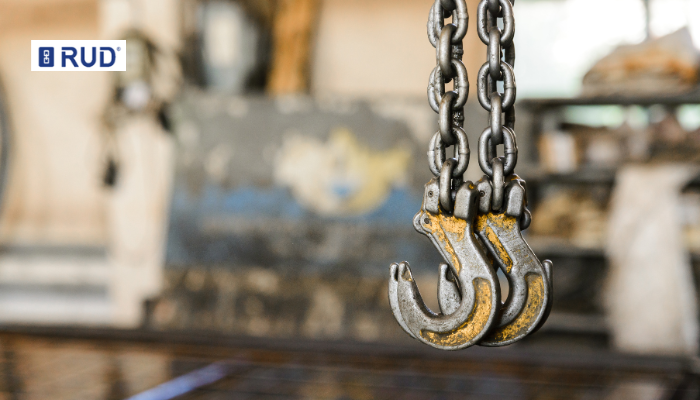
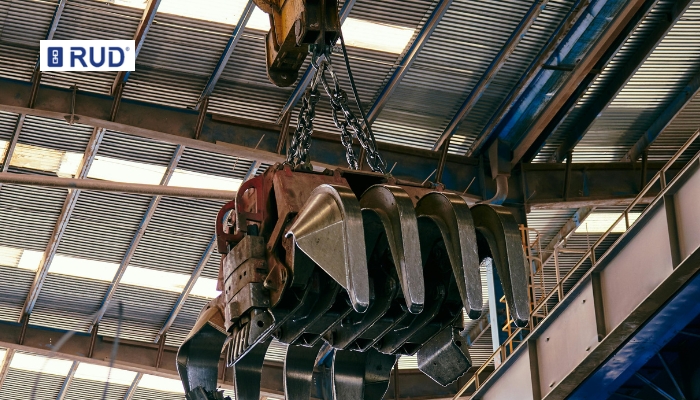
That toughness is why you’ll find them across mining, construction, manufacturing, and port operations throughout Australia. At the Port of Brisbane, for instance, teams regularly rely on them for cargo transport and equipment handling. In those environments, load security is non-negotiable (and a failed lift means more than just downtime).
Beyond ports and mine sites, chain slings cover a lot of ground, including workshops, fabrication yards, and large infrastructure projects. And in all of them, the right selection from the start saves time, money, and unnecessary risk.
Load Requirements: The First Thing You Need to Work Out
We often see under-rated slings as the starting point of lifting incidents on site. In fact, from what we’ve observed throughout projects in Australia, load miscalculation is involved in around 3 in 10 chain sling failures. That’s why your first step is always to establish the working load limit, then consider how load shape and usage frequency affect it. We cover both below.
Working Load Limit and Safety Margins
The working load limit, or WLL, is the maximum load a sling can carry safely under normal operating conditions. Every sling carries a WLL rating, and the actual load must always sit below it. Otherwise, the sling operates outside its rated capacity, which can lead to link deformation, sling failure, or a dropped load. That’s why riggers often build in a safety margin of around 20% above the maximum expected load.
Load Shape, Balance, and Lift Frequency
Load shape and balance play a major role in how sling leg angles affect force distribution. For example, a wide sling angle during a lift can increase the force on each leg. As a result, a sling rated for vertical lifting may fall short at wider angles. That’s why you should always check the angle factor before finalising the selection.
Beyond angle, load shape also affects force distribution. When a load is asymmetrical or unbalanced, the centre of gravity shifts and creates uneven stress across individual sling legs. In these cases, multi-leg configurations help distribute weight more evenly and improve stability during the lift. High-frequency operations add another factor, as repeated lifting cycles introduce fatigue that can reduce service life.
Chain Grades Explained: Grade 80, 100, and 120
Chain grade determines how much load a sling can handle and how well it performs in demanding conditions. The grade refers to the minimum breaking force of the steel. Each increase in grade delivers a stronger, lighter chain for the same diameter. In Australia, three grades cover most industrial lifting applications:
- Grade 80: Grade 80 is the baseline standard for general industrial lifting across most Australian worksites. It meets AS 2321 and AS 3775, the Australian Standards for chain sling compliance, and works well in predictable, stable operating conditions.
- Grade 100: A step up in tensile strength, Grade 100 generally offers a higher WLL than Grade 80 at the same diameter. That means less total chain weight on the lift without sacrificing capacity, which makes it suitable for heavier or more demanding applications.
- Grade 120: This grade offers the highest strength-to-weight ratio available, so it allows heavier loads without added chain weight. It can also handle the most demanding conditions, including offshore, mining, and heavy plant operations where standard grades fall short. RUD’s ICE chain is a good example of Grade 120 performing in those environments.
If any component is lower rated, it’ll limit the working load capacity of the entire assembly. So always verify that every hook, link, and connector matches the chain grade before use.
Which Sling Configuration Do You Need?
Chain sling configurations fall into four types: single-leg, two-leg, three-leg, and four-leg. The correct choice depends on your load’s shape and the position of its centre of gravity.
Single-leg slings suit simple vertical lifts where the load is evenly balanced, and the centre of gravity sits directly beneath the lifting point.
When the load shifts off-centre or requires better control through two anchor points, a two-leg configuration provides improved stability and load distribution. They’re common in fabrication yards and workshops across Brisbane and Ipswich, where load shapes vary from one lift to the next.
For larger, heavier, or irregularly shaped loads, three and four-leg configurations take over. The additional legs help distribute force more evenly across the sling assembly and reduce the risk of load rotation during lifting. In these applications, riggers select leg angles and lengths to maintain stability and keep the load level throughout the lift.
Environmental Conditions That Affect Chain Sling Performance
Not every worksite is the same, and conditions like heat, corrosion, and abrasion affect how long a chain sling lasts in the field. A sling specified correctly for load capacity can still wear out early if the environment it operates in isn’t accounted for. Three conditions in particular are worth checking before finalising your selection:
- Corrosive Environments: Coastal and chemical worksites accelerate corrosion on chain links and fittings. In these settings, slings need the right surface coating or steel specification to stay safe and maintain their rated capacity over time.
- Temperature Extremes: Heat and cold both affect chain strength in ways that don’t always show visible signs. That’s why you should always check the manufacturer’s temperature ratings before using a sling in environments with noticeable temperature variation.
- Abrasive Conditions: Sites that handle aggregates, raw materials, or rough surfaces wear chains down faster than typical industrial conditions. Protective sleeves or a higher-grade chain can extend service life in these environments and reduce the frequency of replacement.
Different operating conditions call for different solutions. Depending on the environment, that may involve a coating upgrade, a grade change, or a protective sleeve. Identifying the right fix early saves money on replacements and keeps the sling within its rated capacity. If you’re unsure which applies to your site, check with your supplier before finalising the specification.
Choosing a Chain Sling That Matches the Application
Getting the load limit, configuration, chain grade, and operating environment right before the sling goes into service is what separates a reliable lift from an avoidable problem. Compliance also forms part of that process. Traceability records need to be on hand for site inspections, so confirm documentation requirements with your supplier early.If you’re still unsure which configuration or grade suits your application, our team at RUD Australia can help. We work with customers across Australia on a range of lifting applications, including Grade 80, 100, and 120 chain systems supplied with full compliance documentation.